Six Bags, One Basket: The Kitchen Cupboard That Finally Makes Sense
Every UK kitchen has one. You open the cupboard under the sink for a bottle of washing-up liquid and a soft avalanche of handles comes out with it. There are bags for life, bags from a supermarket you no longer use, a canvas tote from a conference in a city you barely remember, and at least one plastic carrier folded into a triangle so neat it feels cruel to unfold it.
It is not really a storage problem. It is a decision problem. Bags arrive constantly, almost never leave, and have no agreed home beyond somewhere under the sink. The fix is not a bigger cupboard or a cleverer hook. It is a working limit, a small number of jobs, and one basket that acts as the gatekeeper.
Start by emptying the cupboard, not by organising it
Take everything out. Yes, everything. Put the bags on the floor or the kitchen table and wipe out the cupboard while it is empty. This is the only moment you will get a clear view of what is actually in there.
As you handle each bag, check the basics. Is the handle still attached? Is the base split? Does it smell faintly of something you would rather not identify? A bag for life is not a bag for ever. If it cannot carry a bag of potatoes without threatening to fail halfway down the street, it has finished its working life. Textile recycling or the supermarket collection point is the right next stop, not the back of the cupboard.
Give each bag a job, not a backstory
A bag earns its place by doing a job. In most homes, the useful jobs are fairly predictable:
- The weekly shop. Two sturdy bags that can handle tins, milk and a heavy bag of onions.
- The car boot. A small set that lives in the boot, not in the kitchen, so you are never caught out by an unplanned stop.
- Donation runs. One bag that is allowed to sit by the door only while it is being filled, then goes straight into the car.
- The good folding bag. A compact tote or foldable shopper for the handbag, backpack or glovebox.
- The spare. One clean, strong carrier for the odd awkward errand.
That is roughly six bags for many households. If you have a larger family or a longer walk from the car, adjust the number. The point is not six as a magic figure. The point is a number you can name, fit into one container and maintain without thinking about it.
The tote from the conference, the freebie from a festival, the bag with the nice print but a broken zip: these are not jobs. They are memories or maybes. If you love the print, use it as a reusable gift bag or pass it on. If you are keeping it only because it feels wasteful to let it go, remember that keeping a bag you never use is also a form of waste. It takes up space, collects crumbs and makes the useful bags harder to find.
Set a container limit, not a vague intention
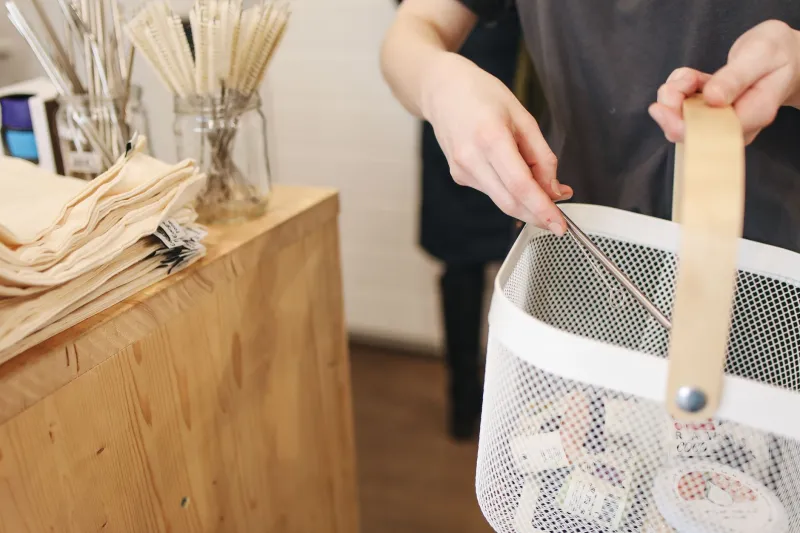
Find one basket, tub or deep drawer insert that fits the space under the sink. This is now the bag basket. The rule is simple: if the bags do not fit in the basket, there are too many bags.
This works because it is visible and physical. A mental rule like 'I should have fewer bags' is easy to ignore at 7pm on a Tuesday. A basket that will not close is harder to argue with. It also gives you a quick way to audit the cupboard without pulling everything out. If the basket is overflowing, something needs to leave.
Keep the basket on the floor of the cupboard rather than shoved to the back. You want to open the door and see handles, not a compressed bag brick. If your cupboard is particularly shallow, a small upright bin or a sturdy cardboard box cut down to size will do the same job.
Fold for grabbing, not for showing off
You do not need a perfect retail fold. You need to be able to see what you own and pull out one bag without bringing the rest with it.
Stand sturdy bags upright in the basket like files. Fold totes flat and stack them at one end. Keep the folding bag near the front, because it is the one you are most likely to grab on the way out. Plastic carriers that are still in good condition can be folded into triangles and tucked into a side pocket of the basket, but only a couple. A neat triangle is still clutter if you have twenty of them.
Deal with the car boot and the donation bag separately
The kitchen cupboard should not be the holding bay for every bag in the house. The car boot set lives in the car. A donation bag lives by the door only while it is active, and then it goes into the boot. If a donation bag has been sitting by the door for more than a fortnight, it is no longer a donation run. It is furniture.
This separation matters because bags multiply when they have no fixed address. One bag in the kitchen, one in the hall, one in the boot and one in the pram basket quickly becomes four separate piles. Give each set a home and the kitchen cupboard stops absorbing the overflow.
Use the two-minute monthly reset
Once a month, empty the bag basket onto the worktop. Shake out crumbs, check handles, remove receipts and stray shopping lists, and put the bags back. If a new bag has arrived since last time, one older bag leaves. One in, one out is easier than a big annual sort because it never becomes a big annual sort.
The same rule applies when a supermarket delivery brings new bags to the door. Deal with them that day. Put the useful ones in the basket and move the rest to the car or the recycling. Do not let them join the pile by default.
The aim is not a beautiful cupboard. It is a two-minute grab point. You open the door, take the bag you need, and close it again without a soft avalanche. That is a small win, but it is the kind of small win that makes the rest of the kitchen feel a little calmer.