The Receipt Method: Letting Your Weekly Shop Redesign the Kitchen
There is a particular kind of kitchen storage content that looks lovely and works badly. You know the sort: rows of identical jars, everything decanted, nothing with a use-by date in sight. It photographs beautifully. It also tends to fall apart the moment a real weekly shop lands on the worktop, because it was designed around an idea of shopping rather than the way anyone actually shops.
A better starting point is sitting in your bag or inbox right now: the receipt from your last grocery order. The receipt method is simple. Before you buy a single storage box, look at what you genuinely bring home week after week, where it currently lives, and where it gets in the way. Then build the kitchen around that evidence.
Start with the receipt, not the Pinterest board
Dig out two or three recent receipts, whether that is a paper slip from Aldi, a Tesco Clubcard record, an Ocado email or a click-and-collect confirmation. You are not doing a full financial review. You are looking for patterns.
Ask yourself a few practical questions. Which items appear every single week? Which bulky items do you buy most often? What gets shoved to the back of a cupboard and forgotten? What do you reach for while cooking, and what do you only use once a month?
Most UK households have a short list of repeat offenders: milk, bread, eggs, tea, coffee, cereal, pasta, rice, tinned tomatoes, beans, frozen peas, cleaning spray, bin bags and whatever fruit the household actually eats. Then there are the items that arrive in hopeful moments and linger for months, like a jar of preserved lemons bought for one recipe or a bag of lentils that never quite gets its moment.
Write down your top fifteen to twenty staples. That list is your kitchen's real floor plan. Everything else is supporting cast.
Run a three-question cupboard audit
Stand in front of each cupboard, shelf and drawer and ask three questions. What comes in here every week? Who uses it? How often?
The answers usually reveal a mismatch. The everyday mugs are hidden behind a smoothie maker. The cooking oil is on a high shelf while the novelty biscuit tin has prime real estate. The tea bags are three steps from the kettle because the cupboard nearest the kettle is full of serving dishes used twice a year.
You do not need to empty everything onto the floor and create a weekend project. Work one zone at a time. Pull out anything that has not been used since the last big supermarket sweep, give the shelf a wipe, and put back only what earns its place.
Be honest about accessibility. An organised kitchen is not one where everything matches. It is one where the things you use most are easiest to reach, and the things you use rarely are stored sensibly rather than dramatically.
Reset the kitchen in practical zones
The unpacking zone
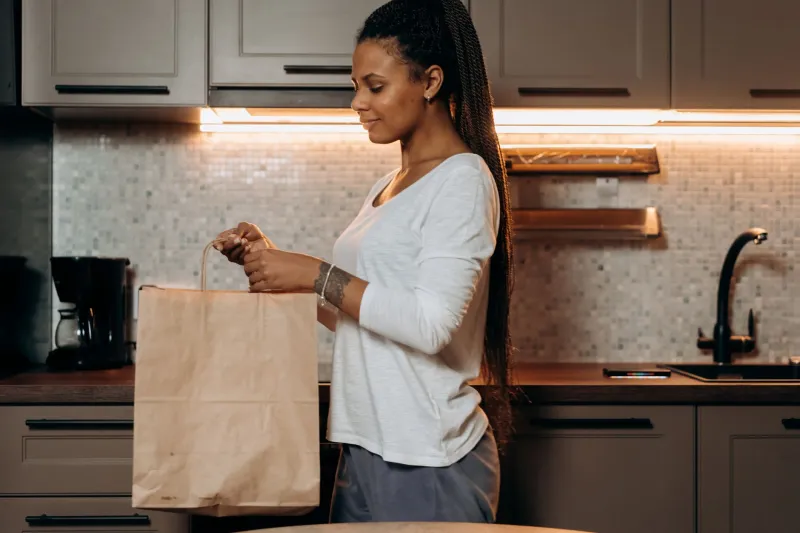
Give the big shop a landing place. A clear stretch of worktop, a sturdy bag-for-life hook and a small tray for items that need dealing with later will do more for kitchen calm than another stack of labelled containers. When you come in with four bags and a child asking about snacks, you need somewhere to put things down before you start solving the puzzle.
The breakfast shelf
Tea, coffee, cereal, porridge oats and spreads all belong within easy reach of the kettle and toaster. If two people make breakfast at the same time, split the shelf so each person has a clear section. Keep the giant catering pack of porridge in a backup zone rather than blocking the daily items.
The cooking zone
This is where the receipt method really pays off. Salt, pepper, oil, stock cubes, tinned tomatoes and the spices you genuinely use should be close to the hob. If you decant spices, do it for speed and visibility, not for a uniform look. If decanting slows you down or makes you forget what is in the jar, leave them in their original packaging and use a small basket instead.
The fridge and freezer
The same logic applies. Keep the door for condiments and drinks, the middle shelves for everyday items, and a clear box or tray for food that needs eating first. In the freezer, group by meal type rather than by package shape: meat and fish together, vegetables together, leftovers together. A frozen pea avalanche is not a storage system.
The backup shelf
Every kitchen needs a home for spares: the second bottle of ketchup, the extra pasta, the bulk toilet roll. Put it high or low, but cap it. If the backup shelf starts to look like a small supermarket, pause your buying rather than hunting for more storage.
Rules for keeping it together after the big shop
A kitchen reset only works if it survives Tuesday night. These rules help.
- Unpack to zones, not to empty spaces. Put the milk where milk lives, not wherever there is a gap.
- Keep a running list on your phone or a notepad so you buy what you need rather than what you fear you have run out of.
- Before you order the next shop, spend five minutes checking the fridge, freezer and backup shelf. It is a small habit that prevents duplicate jars and sad vegetables.
- Do not buy more storage until you have lived with the new layout for a fortnight. Most kitchens need less storage than we think, once the serving platters stop hogging the everyday shelf.
- Review the system monthly, not religiously. If the family keeps dropping the bread in the wrong place, move the bread. The kitchen should follow real life, not the other way round.
Let the kitchen follow the shopping list
The point of this approach is not to create a showroom. It is to create a kitchen that feels slightly easier at 6pm on a wet Wednesday in November, when the bags are on the counter and dinner needs to happen. Your weekly shop is already telling you what your kitchen needs. The receipt method simply asks you to listen.
Start with one shelf and one receipt. Move the tea closer to the kettle. Put the bulk rice where it is not in the way. Give the frozen peas a proper home. Small, evidence-based changes tend to stick far longer than a beautiful system that was never built for your actual life.