Air Rights in the Shed: What Actually Deserves a Hook This November
There is a moment in early November when the shed stops being a workshop and becomes a holding pen. The lawn mower has had its last outing, the secateurs are sticky with sap, and somewhere behind the bike helmets is a bag of compost that has quietly turned into a brick. You do not need more shelving. You need a honest conversation about air rights.
Start with the ceiling test
In a small shed or garage corner, the most valuable real estate is not the floor. It is the space at eye level and the clear run of wall where you can reach something without moving three other things first. Overhead space is premium. It should go to the tools you use often enough to justify the stretch.
So try this: pick up an item and ask whether it deserves to live above your head. If it is a ladder, long-handled loppers, a rake or the shears you reach for every few weeks, fair enough. If it is a broken strimmer you keep meaning to fix, a decorative hanging basket from 2022 or a border fork you bought because it was reduced and have used twice, it has not earned its hook. The ceiling test is less about height and more about honesty. Anything overhead should be light enough to lift safely, sturdy enough to hang, and useful enough to be worth the effort of getting it down.
Triage the tools like a sensible adult
Late autumn is a good time to sort garden tools because the season is already telling you what matters. The mower, hedge trimmer and watering cans are winding down. The hand tools, forks, trowels and pruners are still in play for bulb planting, leaf clearing and the last tidy-up.
Make three loose piles: use now, service and store, and not worth keeping. Wipe metal tools with an oily rag, sharpen what needs it, and hang the ones you will need before spring where you can see them. If a tool is rusted solid, missing a handle or has been waiting for a repair since the last cold snap, be realistic. A repair queue is fine if it is small and visible. A pile of maybes is just clutter with a garden theme.
Do not overlook the humble broom and dustpan. If they are buried, you will never sweep out the shed, and if you never sweep it out, the whole space feels worse than it is. Give the everyday sweepers a clear spot by the door.
The half-used bag problem
Compost bags are the shed equivalent of loose receipts. You buy a big bag, use a quarter of it, fold it over, and then find it again in March looking like a fossil. The same goes for part-used bags of grit, bark chippings and potting mix.
Rather than buying another storage box, gather every open bag and check what is actually inside. Tip dry, usable compost into one sturdy tub with a lid, label it, and keep it somewhere you can reach without a torch. Anything sodden, mouldy or full of vine weevil grubs should go to the council green waste collection or your local household waste recycling centre, depending on what your council accepts. Do not tip mystery compost onto the border just to get rid of it.
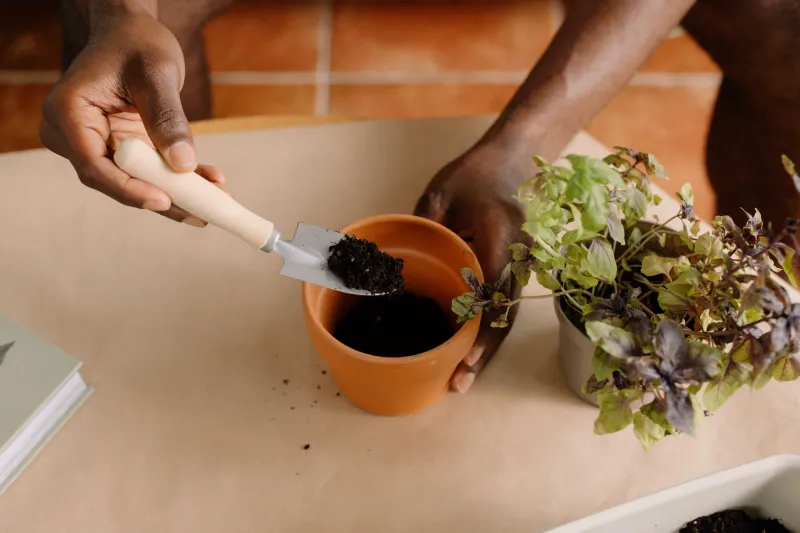
Pots deserve the same clear-eyed approach. Keep a sensible stack of the sizes you genuinely reuse, nest them by size, and let go of the cracked, brittle and wildly oversized ones that never get planted. Terracotta that has gone flaky in the frost is not a future project. It is a heap waiting to happen.
Deal with old chemicals properly
This is the part where a casual clear-out needs to become a careful one. Old weedkiller, slug pellets, wood preservative, paint tins and mystery bottles should not be poured down the drain, tipped into the bin or left at the back of the shelf for another decade. Check your local council website for household waste recycling centre rules. Most UK sites accept garden chemicals in small domestic quantities, but rules vary, so ring ahead if you are unsure.
Keep anything you are retaining in its original container, upright and clearly labelled. If a label has worn away, it is not a gamble worth taking. Take it to the tip. And if you have children, pets or allotment neighbours who borrow things, store chemicals well above reach and away from anything edible or drinkable.
Make the useful stuff visible
A shed does not need to look like a lifestyle photograph. It needs to work on a wet Tuesday when you have five minutes to find the bulb planter. Visible zones do that better than a beautiful matching system.
Try a simple layout: everyday hand tools near the door, long-handled tools along one wall, pots and compost together, and a clearly marked box for string, twine, labels and gloves. Keep the floor as clear as you reasonably can so you can step in without performing a small obstacle course. If you have a garage corner instead of a shed, the same logic applies: put the things you use most where you can see them, and move the seasonal maybes to the less convenient spots.
Before you close the door, take one last look at the ceiling. Anything hanging there should be something you would be glad to see in March. If it is not, it has just failed the test.